1 Mark
A) What is the formal defining property of a transitive relation on set $A$?
1 Mark
B) If $(2x + 3, y - 4) = (11, 5)$, what are the respective values of $x$ and $y$?
1 Mark
C) In the circular arc relation $l = r\theta$, what must be the mandatory unit of angle $\theta$?
1 Mark
D) Which relation accurately connects degrees ($D$), grades ($G$), and radians ($C$)?
1 Mark
E) The product $(\csc \theta + \cot \theta)(\csc \theta - \cot \theta)$ reduces directly to which fundamental identity?
1 Mark
F) What is the locus of a point moving at a fixed distance $r$ from a constant center point $O$?
1 Mark
G) In what ratio does the $X$-axis divide the line segment joining $P(4, -3)$ and $Q(-2, 6)$?
1 Mark
H) For what value of $m$ are the three points $P(1, 2)$, $Q(3, 6)$, and $R(5, m)$ collinear?
1 Mark
I) Given vectors $\vec{u} = \begin{pmatrix} 2 \\ -1 \end{pmatrix}$ and $\vec{v} = \begin{pmatrix} -1 \\ 5 \end{pmatrix}$, compute the linear combination $3\vec{u} - \vec{v}$:
1 Mark
J) What is the percentile equivalence corresponding to the median of any ordered distribution?
1 Mark
K) For the rational function $g(x) = \frac{7x + 2}{x^2 - 9}$, at which real values of $x$ is the function undefined?
2. A bullet train's velocity $v(t)\text{ km/h}$ over elapsed time $t$ in hours satisfies the relation $v(t + 3) = 6t + 11$.
- State the formal definition of a mathematical function. 1 Mark
- Derive the explicit formula for $v(t)$ and compute the train's velocity at time $t = 4\text{ hours}$. 2 Marks
- Determine the exact elapsed time $t$ at which the velocity reaches $41\text{ km/h}$. 1 Mark
3. A function $g(x) = x^2$ is defined over the discrete domain $D = \{-3, -2, -1, 0, 1, 2, 3\}$.
- Determine the complete range of $g(x)$ in set notation. 1 Mark
- Show and plot the ordered pairs representing the function on a Cartesian graph. 1 Mark
4. Answer the following matrix problems:
- Define a scalar matrix and construct an explicit $2 \times 2$ example. 1 Mark
- Given matrix $M = \begin{bmatrix} 2 & 5 & 4 \\ 3 & 9 & 6 \end{bmatrix}$, evaluate the scalar operation: $(m_{13} \times m_{21}) \div m_{23}$. 1 Mark
- If the additive inverse of matrix $\begin{pmatrix} -3 & 8 \\ 5 & -2 \end{pmatrix}$ is $\begin{pmatrix} x - 1 & -8 \\ -5 & y + 4 \end{pmatrix}$, solve for $x$ and $y$. 2 Marks
5. Systems of angular measurement (Sexagesimal, Centesimal, and Circular):
- Define one radian ($1^c$) with its precise geometric relationship. 1 Mark
- An angle of $60^g$ is subtracted from $85^\circ$. Express the remaining angle in sexagesimal degrees. 1 Mark
- The numerical sum of centesimal grades, centesimal minutes, and centesimal seconds of an angle is $404040$. Convert the angle into circular radians. 1 Mark
6. Let $u = \sqrt{\frac{1 + \sin\theta}{1 - \sin\theta}}$ and $v = \sqrt{\frac{1 - \sin\theta}{1 + \sin\theta}}$.
- Prove analytically that: $u = 1+ \sin \theta$. 1 Mark
- Evaluate and simplify the sum $u + v$ into a concise single-term expression. 2 Marks
7. Consider the conditional trigonometric identity: $\frac{\cot \theta + \csc \theta - 1}{\cot \theta - \csc \theta + 1} = \frac{1 + \cos \theta}{\sin \theta}$.
- Write down the reciprocal ratio of $\cot \theta$. 1 Mark
- Prove the validity of the identity algebraically. 2 Marks
8. Analyze the coordinate geometry diagram presented below:
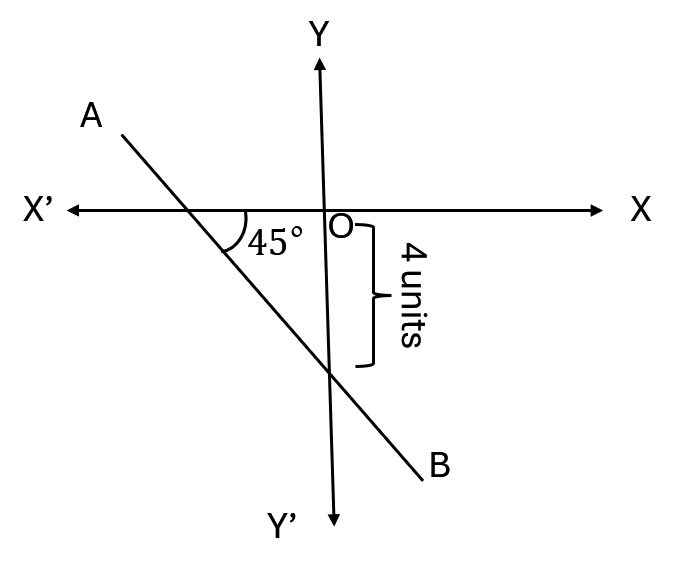
- State the standard slope-intercept form equation of a straight line. 1 Mark
- Determine the numerical slope of line $L$. 1 Mark
- Find the Cartesian equation of line $L$. 1 Mark
9. The four vertices of parallelogram $PQRS$ are $P(p, q)$, $Q(1, -3)$, $R(7, 2)$, and $S(4, 6)$.
- Find the midpoint of diagonal $QS$ and write the expression for the midpoint of diagonal $PR$. 2 Marks
- Using the property of bisecting diagonals, calculate the coordinates of vertex $P$. 2 Marks
10. $\Delta ABC$ with vertices $A(2, 3)$, $B(5, 1)$, and $C(3, -2)$ is rotated through $180^\circ$ about the origin $(0, 0)$.
- Is a $+180^\circ$ clockwise rotation geometrically distinct from a $-180^\circ$ anticlockwise rotation? Explain. 1 Mark
- Determine the coordinates of image vertices $A', B', C'$ and plot both the object and image triangles on the same coordinate axis. 3 Marks
11. Given two vectors $\vec{MN} = \begin{pmatrix} 5 \\ -2 \end{pmatrix}$ and $\vec{KL} = \begin{pmatrix} -2 \\ 6 \end{pmatrix}$:
- State the algebraic vector addition rule for column vectors $\vec{a} = \begin{pmatrix} x_1 \\ y_1 \end{pmatrix}$ and $\vec{b} = \begin{pmatrix} x_2 \\ y_2 \end{pmatrix}$. 1 Mark
- Compute the vector sum $\vec{MN} + \vec{KL}$ and calculate its direction angle with respect to the positive $X$-axis. 1 Mark
- A student claims that the unit vector along $(\vec{MN} + \vec{KL})$ is $\begin{pmatrix} 3/5 \\ 4/5 \end{pmatrix}$. Verify whether this claim is correct or incorrect by evaluating the actual unit vector. 1 Mark
12. The scores of 11 students in a test are: $48, 22, 35, 41, 19, 29, 50, 44, 38, 31, 26$.
- What essential preprocessing step is necessary before computing quartiles in an individual series? 1 Mark
- Compute the first quartile ($Q_1$) of the scores. 1 Mark
- A student claims $Q_3 = 44$ because $44$ is the $8^{\text{th}}$ number in the original raw list. Is this correct? Give reasons. 1 Mark
13. Consider the sequence defined by $u_n = 2 - \frac{1}{n}$ for $n \in \mathbb{N}$:
- Evaluate the numerical value of $u_4$. 1 Mark
- What is the limiting behavior of $\frac{1}{n}$ as $n \to \infty$? 1 Mark
- List the first four terms and state the approaching limit of the sequence. 1 Mark
- If the sequence is replaced by $w_n = 2 + \frac{1}{n}$, will its limiting value change? Examine and justify. 1 Mark
14. [Geometry + Vectors + Locus]
A quadrilateral $EFGH$ has vertices $E(-3, 1)$, $F(1, 4)$, $G(4, 2)$, and $H(h, k)$.
- If the reflection of vertex $H$ across the line $x = 1$ yields the image $H'(-1, 5)$, find the coordinates of vertex $H$. 1 Mark
- Calculate the absolute scalar lengths $|\vec{EG}|$ and $|\vec{FH}|$. 2 Marks
- Using column vectors, prove that $\vec{EF} + \vec{FG} + \vec{GH} + \vec{HE} = \vec{0}$. 1 Mark
- Determine whether the locus of points equidistant from $F(1, 4)$ and $G(4, 2)$ is $6x - 4y - 3 = 0$. Justify completely. 2 Marks
15. [Algebra + Statistics + Limits]
A data set $S$ is obtained via $f(x) = 2x + 1$ for domain $x \in \{3, 4, 5, 6, 7\}$.
- List the elements of set $S$ and compute its mean deviation from median. 3 Marks
- Given $h(x) = x^2 - 3x - 5$, determine the values of $x$ for which $f(x) = h(x)$. 2 Marks
- If $x$ approaches $2$ through $x = 1.9, 1.99, 1.999, 1.9999$, evaluate the limiting value of $f(x)$. 1 Mark
16. [Trigonometry + Calculus Limits]
Use trigonometric properties to solve the following:
- Prove that: $\tan \alpha + \cot \alpha = \sec \alpha \cdot \csc \alpha$. 2 Marks
- Prove the identity: $(1 - 3 \tan^2 A)(4 \cos^2 A - 3) = (3 - 4 \sin^2 A)(1 - 3 \tan^2 A)$. 2 Marks
- Can $\sin \theta$ be completely expressed in terms of $\cos \theta$ across all quadrants? Justify. 1 Mark
- As $x \to 90$, evaluate $\lim_{x \to 90} \frac{x^2 - 8100}{x - 90}$ by completing the table below: 1 Mark
$x$ 85 86 87 88 89 $F(x)$
17. [Matrices + Coordinate Geometry]
Let $P = \begin{bmatrix} 3 & -1 \\ 2 & 5 \end{bmatrix}$, $Q = \begin{bmatrix} 2 & 4 \\ -1 & 3 \end{bmatrix}$, and points $M(1, 2)$, $N(7, 11)$ be given.
- Find the matrix $3P - 2Q$. 2 Marks
- What specific alteration will transform matrix $P$ into a scalar matrix? 1 Mark
- If points $X$ and $Y$ trisect line segment $MN$, find the coordinates of trisection point $Y$ closer to $N$. 2 Marks
- Aarav claims: "$X$ is the midpoint of $MY$." Diya claims: "$Y$ divides $MN$ in ratio $2:1$." Who is correct? Justify. 1 Mark