Sets
Digital Handwritten Lesson
New Millennium Academy
Birauta, Pokhara-17, Kaski, Nepal
Definition of a Set
A set is a well-defined collection of distinct objects. These objects are called the elements or members of the set.
Sets are denoted by capital letters: A, B, C, …, X, Y, Z.
Elements are written inside curly braces — they may be letters, numbers, names, or any well-defined objects.
- \(A = \{a, e, i, o, u\}\)→A set of vowels
- \(B = \{2, 4, 6, 8, 10\}\)→First five even numbers
- Well-defined: There must be a clear rule to decide whether any object belongs to the set. "Collection of tall people" is not a set (subjective). "People over 6 feet tall" is a set.
- Distinct: Each object is unique. If an element is listed more than once, it is still one member.
- Order-independent: \(\{1, 2, 3\}\) is the same set as \(\{3, 1, 2\}\).
Relation Between the Sets
A. Overlapping Sets
Ram formed \(R = \{2, 4, 6, 8, 10, 12\}\) — the first 6 even numbers.
Sita formed \(S = \{3, 6, 9, 12, 15\}\) — the first 5 multiples of 3.
- Sets \(R\) and \(S\) have \(6\) and \(12\) in common.
- Elements \(6\) and \(12\) are present in both sets \(R\) and \(S\).
Sets \(R\) and \(S\) are Overlapping Sets.
Two sets are said to be overlapping sets if they have at least one (थोरैमा पनि एउटा) element in common.
B. Disjoint Sets
Teacher asked Jay and Biru to write sets using 4 elements:
Jay wrote \(J = \{1, 3, 5, 7\}\) — first 4 odd prime numbers.
Biru wrote \(B = \{2, 4, 6, 8\}\) — first 4 even numbers.
- Sets \(J\) and \(B\) have no element in common.
- Sets \(J\) and \(B\) have completely distinct elements.
Sets \(J\) and \(B\) are Disjoint Sets.
Two sets are said to be disjoint sets if no element is common between them.
Venn Diagram
History: Venn diagram was developed by John Venn in the 1880s.
Purpose: To show the relationships between different sets.
Key Components:
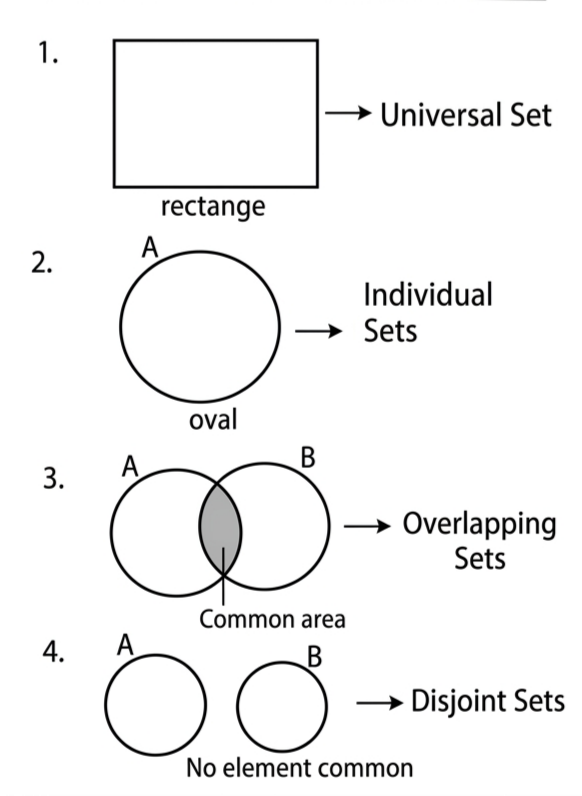
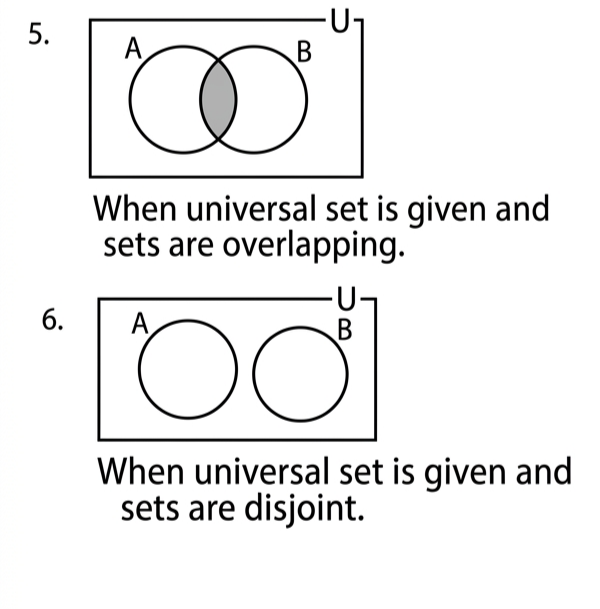
A Venn diagram is a tool (साधन) used to show relationships between sets.
i) Be aware of the universal set. If a universal set is given, draw an outer rectangle (like figures 5 or 6); otherwise no rectangle is needed (like figures 3 or 4).
ii) Identify whether the sets are overlapping or disjoint:
- a) If overlapping → draw figure 3 (two circles that overlap) and fill the common elements first in the overlapping region.
- b) If disjoint → draw figure 4 (two separate, non-touching circles).
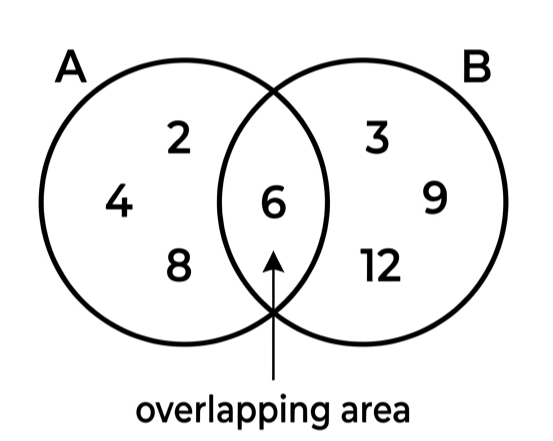
Let:
- Set \(A = \{2,\ 4,\ \boxed{6},\ 8\}\)
- Set \(B = \{3,\ \boxed{6},\ 9,\ 12\}\)
Venn Diagram Breakdown:
The diagram shows two overlapping circles labeled A and B.
- Set A only: \(\{2, 4, 8\}\) — elements unique to A.
- Overlapping area: \(6\) is common to both sets, so it is placed here.
- Set B only: \(\{3, 9, 12\}\) — elements unique to B.
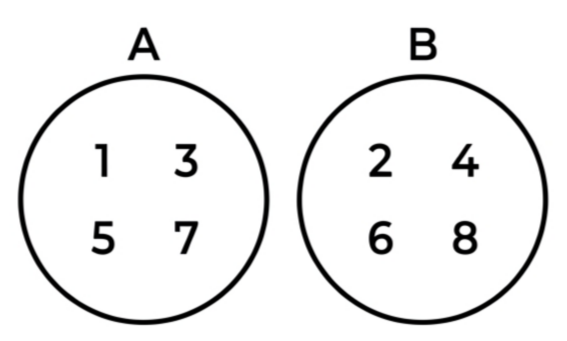
Let:
- Set \(A = \{1, 3, 5, 7\}\)
- Set \(B = \{2, 4, 6, 8\}\)
Venn Diagram Breakdown:
Because there are no common elements, the diagram shows two completely separate (non-touching) circles labeled A and B.
- Circle A: Contains \(\{1, 3, 5, 7\}\).
- Circle B: Contains \(\{2, 4, 6, 8\}\).
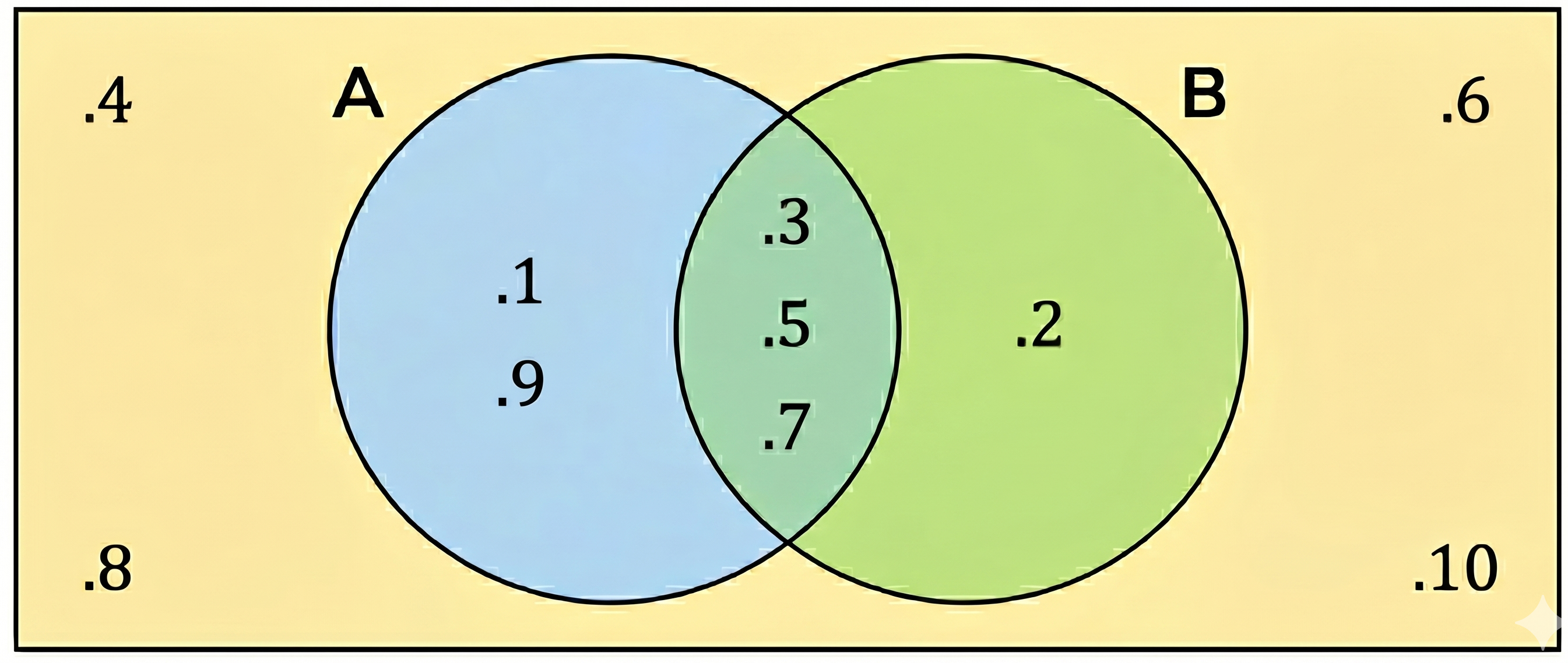
Universal Set \(U\):
\[U = \{1, 2, 3, 4, 5, 6, 7, 8, 9, 10\}\]Set \(A\) (Odd Numbers):
\[A = \{x : x \text{ is an odd number and } x \in U\}\] \[A = \{1,\ \boxed{3},\ \boxed{5},\ \boxed{7},\ 9\}\]Set \(B\) (Prime Numbers):
\[B = \{x : x \text{ is a prime number and } x \in U\}\] \[B = \{2,\ \boxed{3},\ \boxed{5},\ \boxed{7}\}\]Venn Diagram:
Subsets, Proper Subsets & Improper Subsets
Let \(A = \{1, 2, 3\}\). All sets that can be formed using only elements of \(A\):
Gold = Improper subset | Grey = Empty set (like air — present everywhere)
- \(S_1\)–\(S_8\) are all formed using elements of \(A\) only.
- \(S_1\)–\(S_7\) are not equal to \(A\). [Equal and equivalent sets are studied in Grade 7]
- \(S_8\) is equal to \(A\).
- \(S_1\)–\(S_8\) are all subsets of set \(A\).
- \(S_1\)–\(S_7\) are proper subsets.
- \(S_8\) is the improper subset.
A set within a set is called a subset.
Set \(B\) is a proper subset of \(A\) if:
- \(B\) contains elements of \(A\) only, and
- \(B \neq A\)
Set \(B\) is an improper subset of \(A\) if:
- \(A = B\)
Every set is an improper subset of itself.
- The empty set \(\emptyset\) is a subset of every set.
- Each set has exactly one improper subset (itself); all remaining subsets are proper subsets.
Formula for Number of Subsets
| Set | No. of elements (\(n\)) | All Subsets | No. of subsets |
|---|---|---|---|
| \(\{a\}\) | 1 | \(S_1=\{a\},\ S_2=\{\}\) | \(2 = 2^1\) |
| \(\{a, b\}\) | 2 | \(S_1=\{a\},\ S_2=\{b\},\ S_3=\{a,b\},\ S_4=\{\}\) | \(4 = 2^2\) |
| \(\{a, b, c\}\) | 3 | \(S_1=\{a\},\ S_2=\{b\},\ S_3=\{c\},\ S_4=\{a,b\},\ S_5=\{b,c\},\ S_6=\{a,c\},\ S_7=\{\},\ S_8=\{a,b,c\}\) | \(8 = 2^3\) |
| — | — | — | — |
| \(\{a,b,c,\ldots\}\) | \(n\) | — | \(2^n\) |
\(\text{(Proper + Improper) subsets} = 2^n\)
\(\text{Proper subsets} + 1 = 2^n\)
\[\therefore\ \text{No. of proper subsets} = 2^n - 1\]
Course material curated by Mr. Nripendraswar Acharya