Composite Function
Digital Handwritten Lesson

New Millennium Academy
Composite Functions – Class 10 Additional Maths
Composite Functions
Understanding function composition with real-life examples, diagrams, and step-by-step explanation
Activity 1
"Double a number and add 3" — apply it for 5.
Calculation 1:
$$2 \times 5 = 10$$
Calculation 2:
$$10 + 3 = 13$$
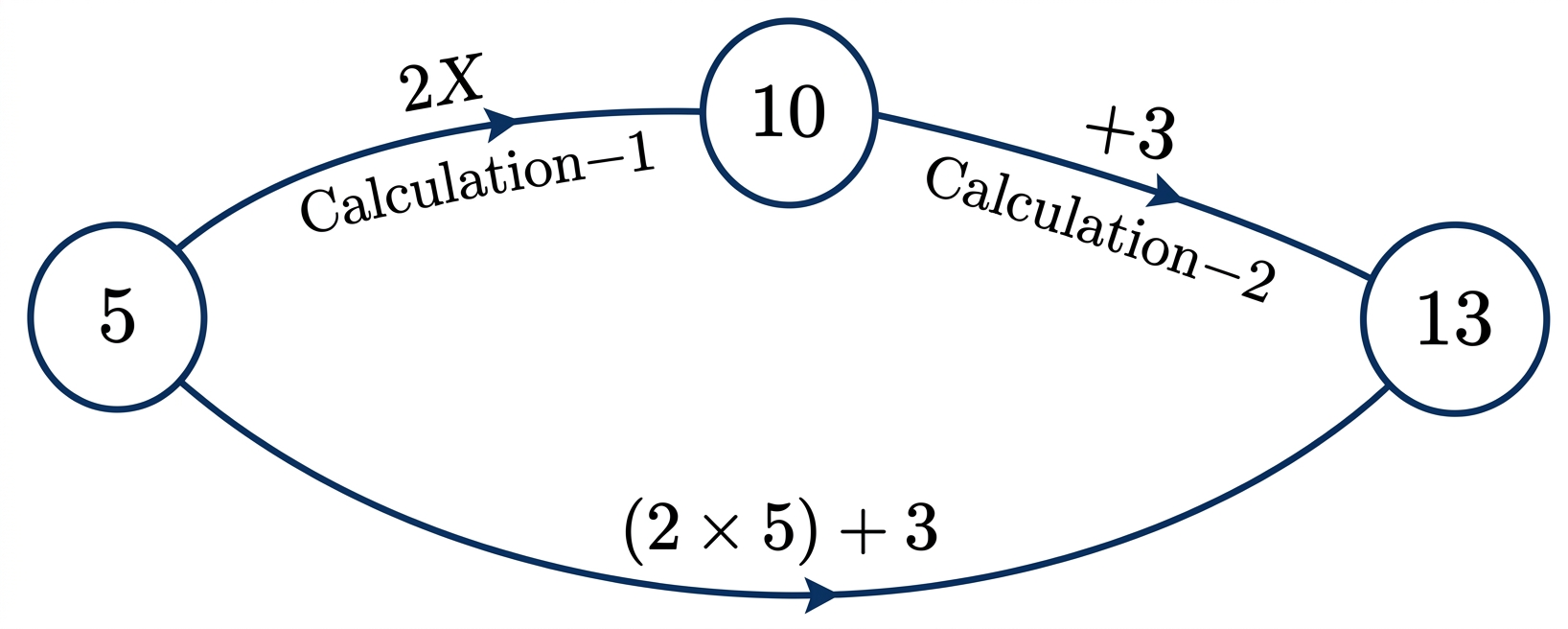
Observation: The initial value of calculation 1 is 5, while the initial value of calculation 2 is 10, which is the result of calculation 1.
Conclusion: Two calculations combine together to give the final result.
Activity 2
Real life analogy with two buses.

Observation:
- Bus A takes Ram from Pokhara to Mugling.
- Bus B takes Ram from Mugling to Kathmandu.
- Ram travels from Pokhara to Kathmandu by using two buses.
Conclusion:
Passenger dropped by Bus A is taken by Bus B; the output of the first step becomes the input of the next step.
Activity 3
Function machine analogy for composite functions.
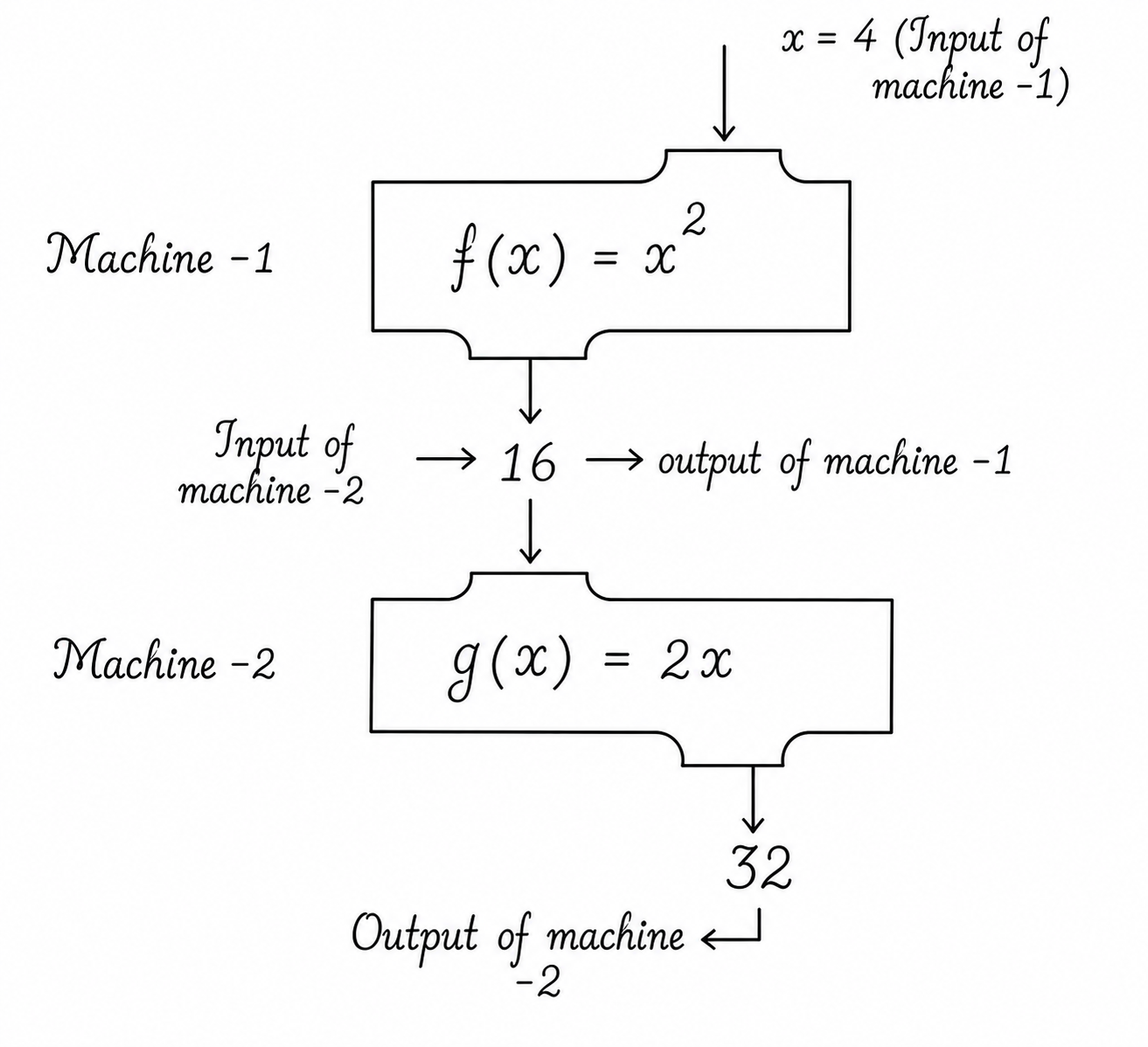
Observation:
- Machine 1 takes 4 and gives 16.
- Machine 2 takes 16 and gives 32.
- From 4 to 32 is the work of two machines together.
Conclusion: The output of one function becomes the input of another; this is called a composite function.
Formal Definition
Composite Function: Let $f: A \rightarrow B$ be a function from set $A$ to $B$ and $g: B \rightarrow C$ be a function from set $B$ to $C$. The function defined from set $A$ to $C$ is called the composite function of $f$ and $g$.
It is denoted by $g \circ f (x)$.
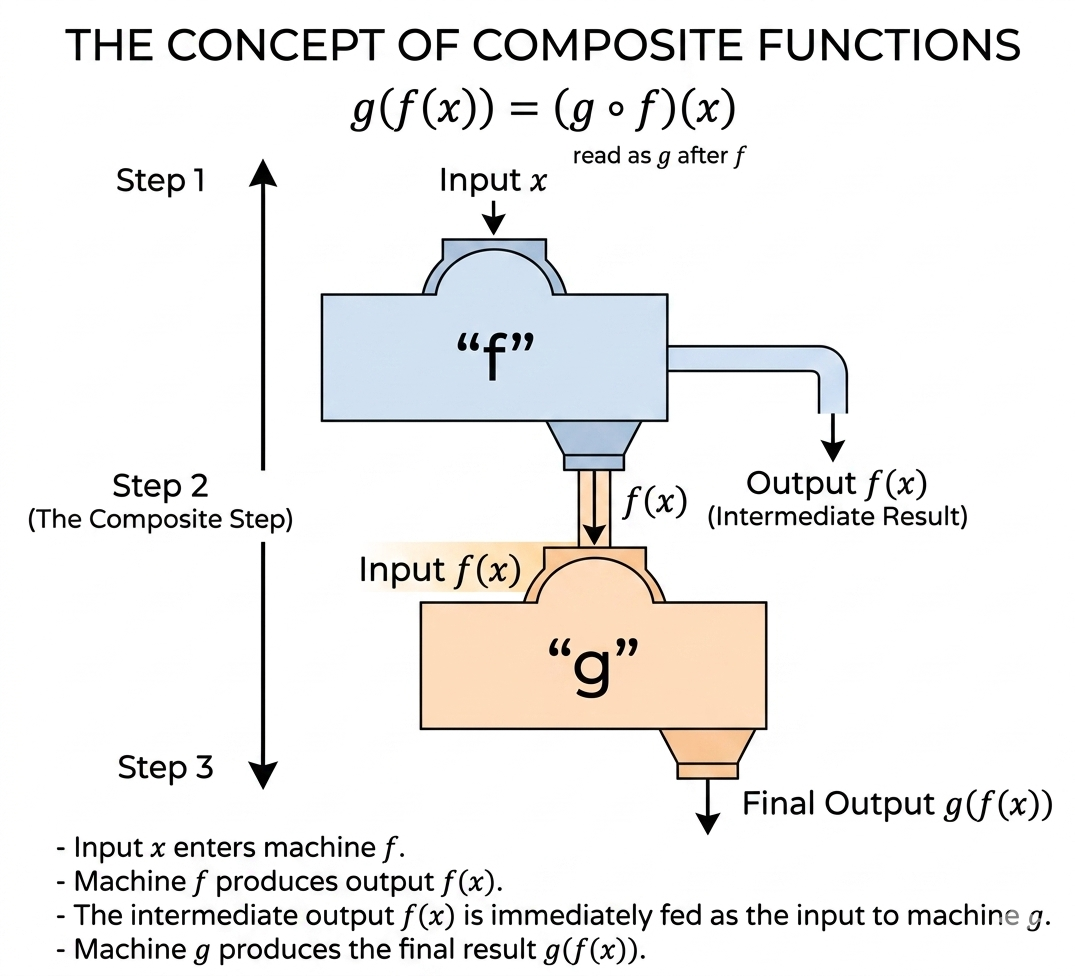
Mathematically:
$$(g \circ f)(x) = g(f(x))$$
Why is it written $(g \circ f)(x)$?
In mathematics, function notation is read from right to left for the order of operations. Because $f$ acts on $x$ first, it is written closer to $x$.
If we wrote $f \circ g$, it would mean "apply $g$ first and then $f$", which is not the same process when $f$ takes the input first.
Composite Function Diagrams
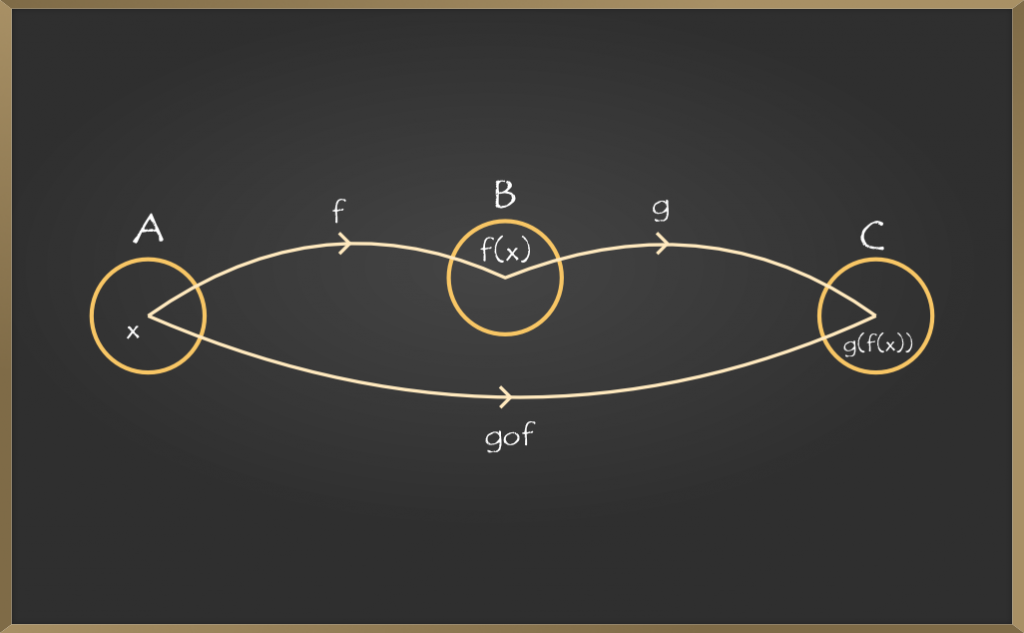
Composite Function with Ordered Pairs
Let $f = \{(a, p), (b, q), (c, r)\}$ and $g = \{(p, 1), (q, 2), (r, 3)\}$.
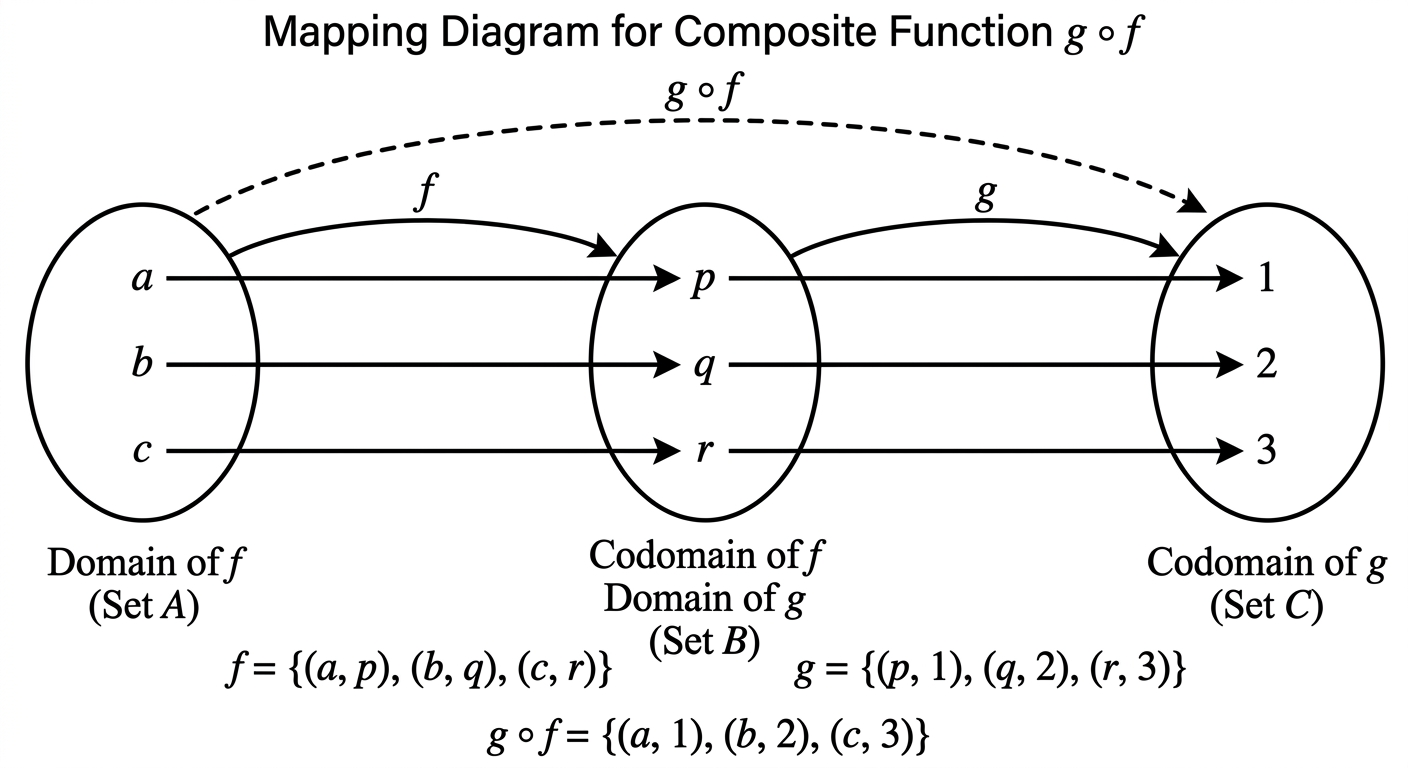
The outputs of $f$ are the inputs of $g$, so the composite is:
$$g \circ f = \{(a,1), (b,2), (c,3)\}$$
Solution:
$$g(f(a)) = g(p) = 1$$
$$g(f(b)) = g(q) = 2$$
$$g(f(c)) = g(r) = 3$$
Composite Function with Formulas
Let $f(x) = 2x - 1$ and $g(x) = 3x + 5$.
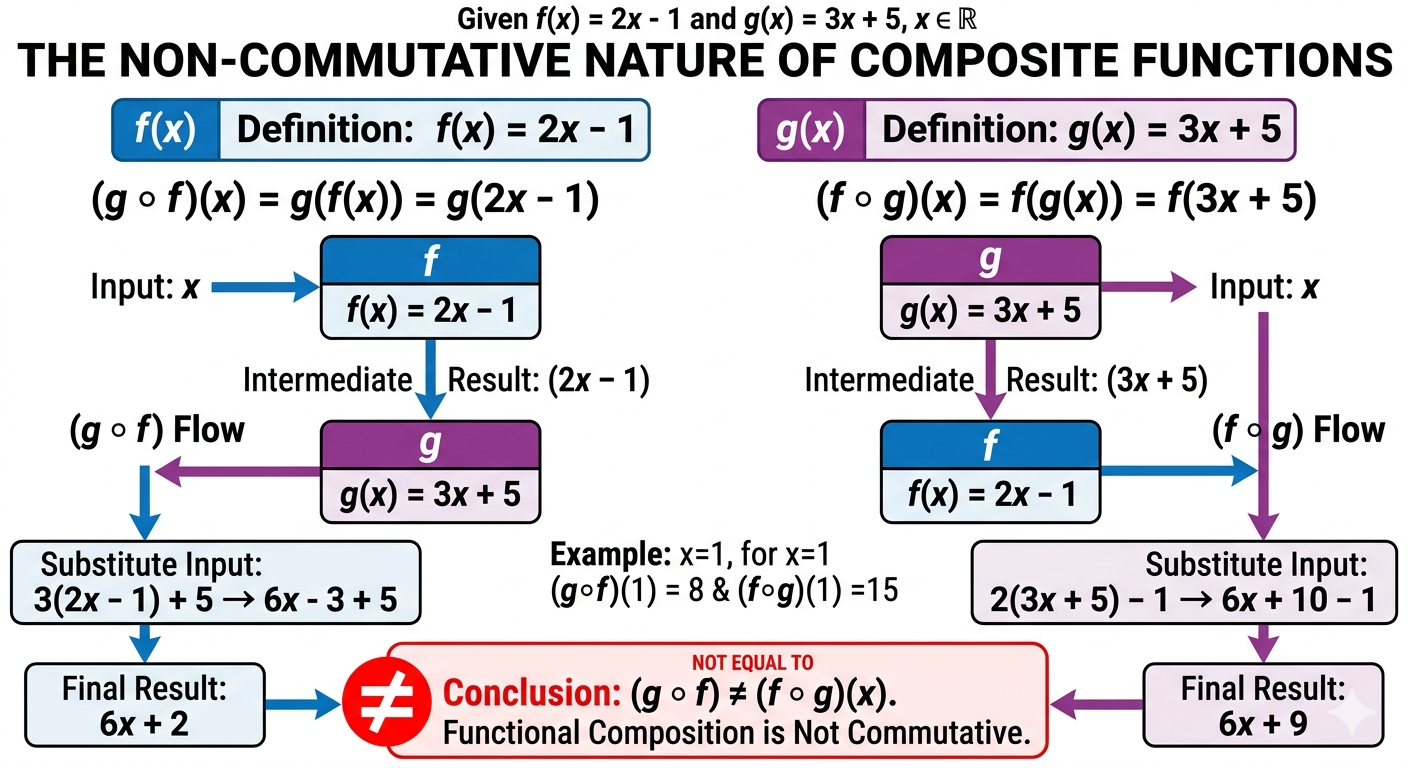
$$ (g \circ f)(x) = g(f(x)) = g(2x-1) = 3(2x-1) + 5 = 6x - 3 + 5 = 6x + 2 $$
$$ (f \circ g)(x) = f(g(x)) = f(3x+5) = 2(3x+5) - 1 = 6x + 10 - 1 = 6x + 9 $$
Conclusion: $(g \circ f)(x) \neq (f \circ g)(x)$, so composite functions are not commutative.
Key Points to Remember
- $f^2 = f \circ f$
- $g^2 = g \circ g$
- For $g \circ f$, domain is the domain of $f$ and range is the range of $g$.
← Return to Chapter
Course material curated by Mr. Nripendraswar Acharya