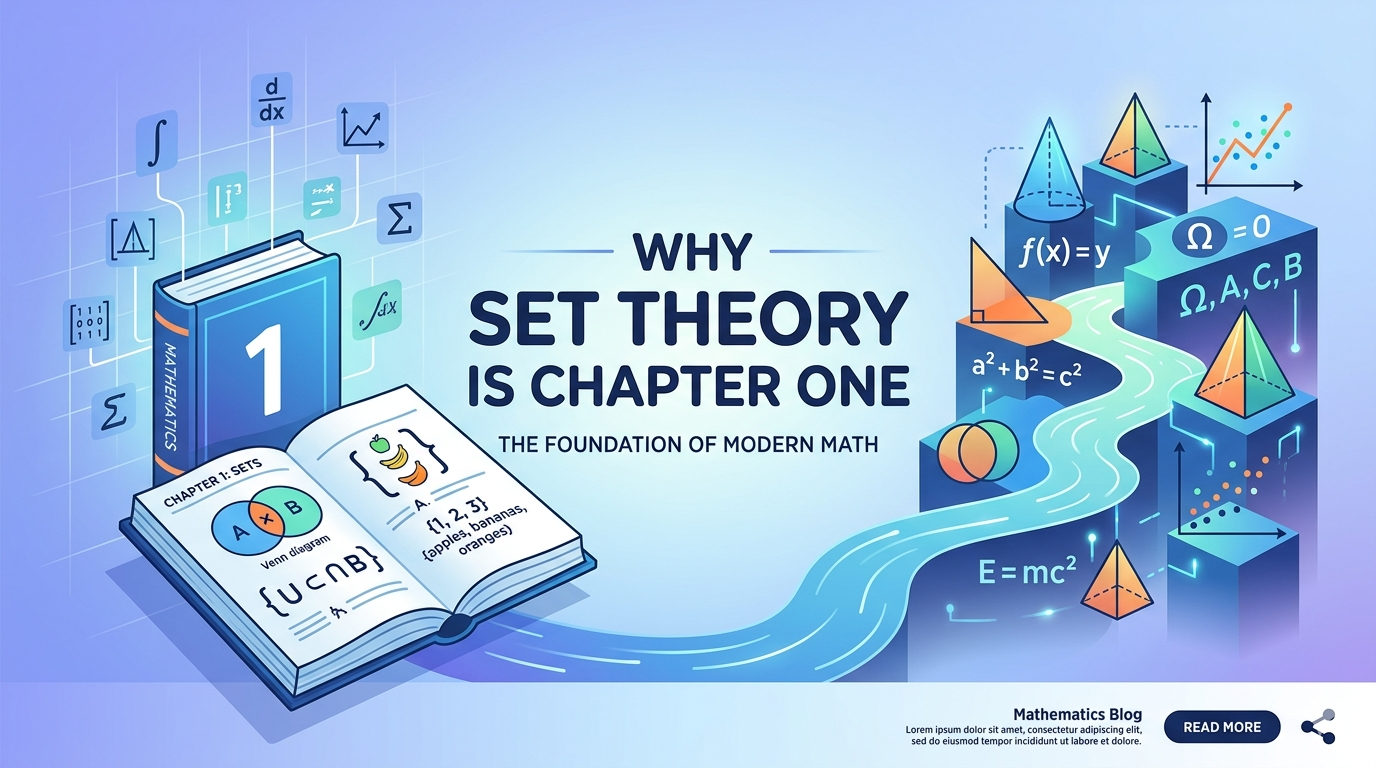
If you’ve ever opened a math textbook, you’ve likely noticed a recurring theme: Chapter 1: Sets. Before you get to the "fun" stuff like calculus or the heavy lifting of linear algebra, you’re stuck defining collections of objects and drawing Venn diagrams.
It might feel like a slow start, but there’s a profound reason for it. Set theory isn't just a topic; it’s the operating system that the rest of mathematics runs on. Here is why sets always get the opening slot.
1. The Universal Language
Mathematics is a global language, but every language needs an alphabet. Sets provide the most basic "nouns" of math. Whether you are talking about a collection of numbers, a group of functions, or a series of geometric points, you are dealing with a set.
By starting with sets, textbooks establish a common vocabulary:
- Elements: The individual members of a group.
- Subsets: Smaller groups within a larger context.
- Universal Set: The "world" or scope we are currently calculating within.
2. Defining Functions and Relations
Most of mathematics—especially algebra and calculus—revolves around functions. But how do you define a function?
Strictly speaking, a function is a specific type of relationship between two sets (the domain and the codomain). You cannot truly understand what $f(x) = y$ means until you understand that $x$ is an element of one set and $y$ is an element of another. Without Chapter 1, Chapter 2 wouldn't have a foundation to stand on.
3. Logic and Precise Thinking
Set theory introduces students to formal logic. Concepts like "And" (Intersection $\cap$), "Or" (Union $\cup$), and "Not" (Complement $A^c$) are the building blocks of logical reasoning.
Teaching sets first trains your brain to:
- Categorize information clearly.
- Identify boundaries (deciding what belongs and what doesn't).
- Analyze overlaps and exclusions in complex data.
4. The "Rigor" Revolution
Historically, mathematics was a bit messy until the late 19th century. Mathematicians like Georg Cantor developed Set Theory to provide a "rigorous foundation." They realized that almost every mathematical concept—from the definition of the number "1" to the infinite complexities of calculus—could be derived from the simple idea of a "set."
By putting sets first, textbooks are following the logical "DNA" of modern mathematics.
How Different Fields Use Sets
| Maths Branch | How it uses sets? |
|---|---|
| Probability | Defines the "Sample Space" as a set of all possible outcomes. |
| Geometry | Views shapes as sets of specific points in space. |
| Algebra | Studies sets of numbers under specific operations like addition. |
| Computer Science | Uses sets for databases, logic gates, and search algorithms. |
Final Thought
Think of Set Theory as the foundation of a house. You don't live in the foundation, and you might not even see it once the house is finished, but without it, the entire structure would collapse. Next time you see those curly brackets $\{ \dots \}$, remember: you aren't just looking at a list. You’re looking at the bedrock of the entire mathematical universe.