In the realm of recreational mathematics and high-stakes psychology, few numbers carry as much weight as 37. It isn't just a prime number; it is a recurring "glitch in the matrix" that appears in everything from human cognitive biases to the fundamental laws of thermodynamics.
Whether you are a fan of trivia, a student of number theory, or a curious observer of human behavior, here is why 37 is considered a truly "magic" number.
1. The "Random" Choice Phenomenon
If you ask a person to pick a "random" number between 1 and 100, a statistically staggering number of people will choose 37.
Psychologists suggest this happens because 37 feels "truly random" to the human brain. It doesn't end in a 5 or a 0 (which feel too structured), it isn't even (which feels too balanced), and it doesn't follow a common pattern like 11, 22, or 33. It feels jagged, unique, and unpredictable—making it the most predictable "random" choice in human history.
2. The 37% Rule (Optimal Stopping)
In the world of computer science and probability, the 37% Rule (or the Secretary Problem) dictates the mathematical point at which you should stop searching and make a commitment to get the best possible result.
If you are interviewing 100 candidates for a job, math suggests you should screen the first 37 without hiring any of them. After that, you should hire the very next person who is better than everyone you’ve seen so far. This gives you the highest statistical probability of picking the absolute best candidate.
This magic threshold is derived from the constant 1/e, which is approximately 0.36787.
3. Biological Precision
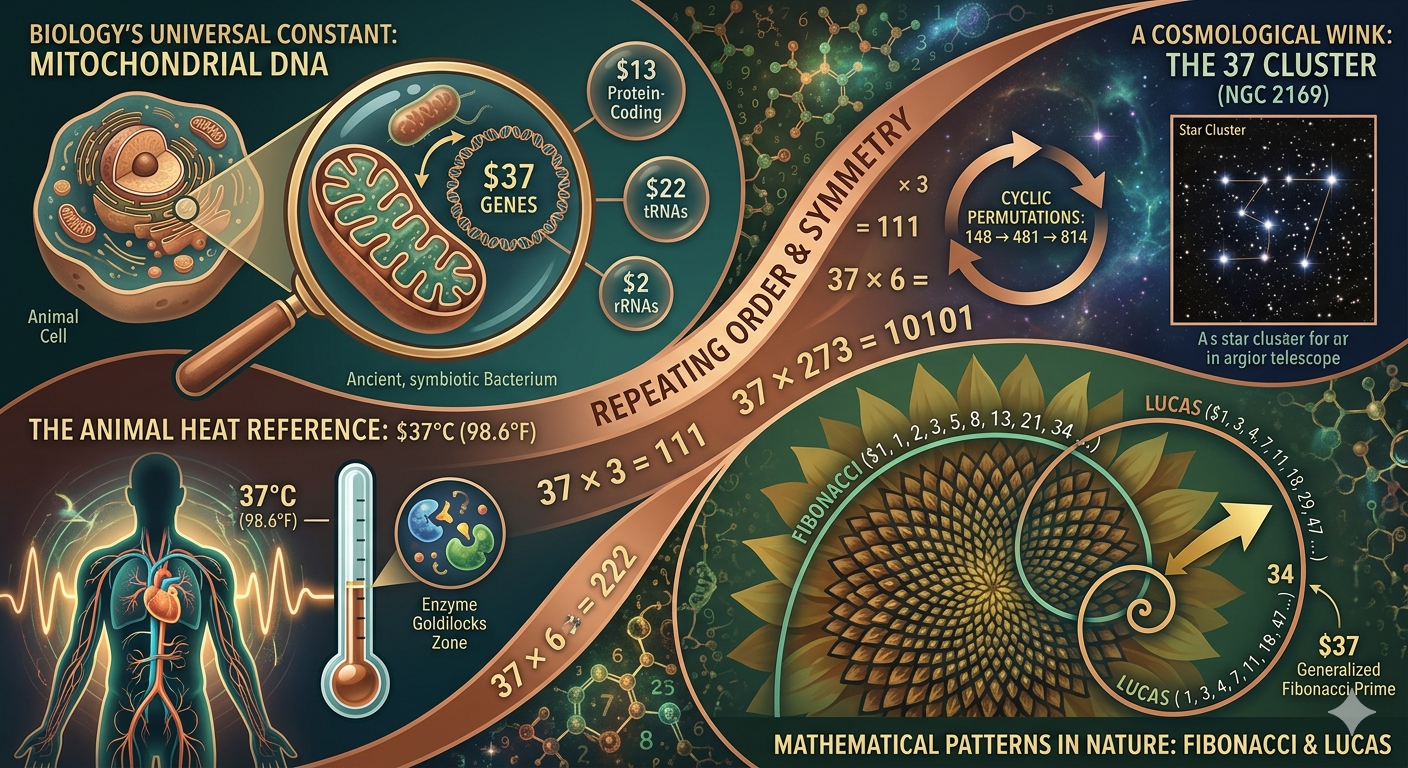
The number 37 is quite literally the "Goldilocks" zone for human existence. The average human body temperature is 37°C.
This isn't a coincidence of evolution. Scientists have found that 37°C is the thermal "sweet spot"—it is high enough to prevent fungal infections from ravaging our systems, but low enough that we don't have to eat constantly to maintain our metabolic fire. It is the temperature of life.
4. Mathematical Elegance
To a mathematician, 37 is a permutable prime and a unique prime. It possesses several mesmerizing properties:
The Repunit Factor: If you take any three-digit number made of the same digits (111, 222, 333), they are all divisible by 37.
$\frac{111}{3}$ = 37
$\frac{999}{37}$ = 27
The Reverse Prime Phenomenon:
As we know 37 is 12th Prime number, the number obtained by reversing 37 is 73, so if we count, we can see 73 is 21th prime number which is reverse of 12.
5. Cosmic and Cultural Echoes
- The Hubble Constant: Some recent measurements of the expansion rate of the universe (the Hubble Constant) have pointed toward values that, through specific lensing, highlight 37 as a recurring factor in cosmic scaling.
- The 37th Parallel: This circle of latitude is often cited in fringe theories as a "paranormal highway" due to the high frequency of reported UFO sightings and ancient monuments located along its path across the United States and the globe.
The Verdict
The number 37 acts as a bridge between the abstract world of mathematics and the physical reality of our bodies and decisions. It is the point where probability meets intuition. Next time you need to pick a number or make a life-changing decision after seeing 37% of your options, remember: the universe might just be giving you a hint.