Understanding Math Through First Principles Thinking
Most students believe mathematics is a subject full of formulas, shortcuts, and complicated rules to memorize.
But the truth is very different.
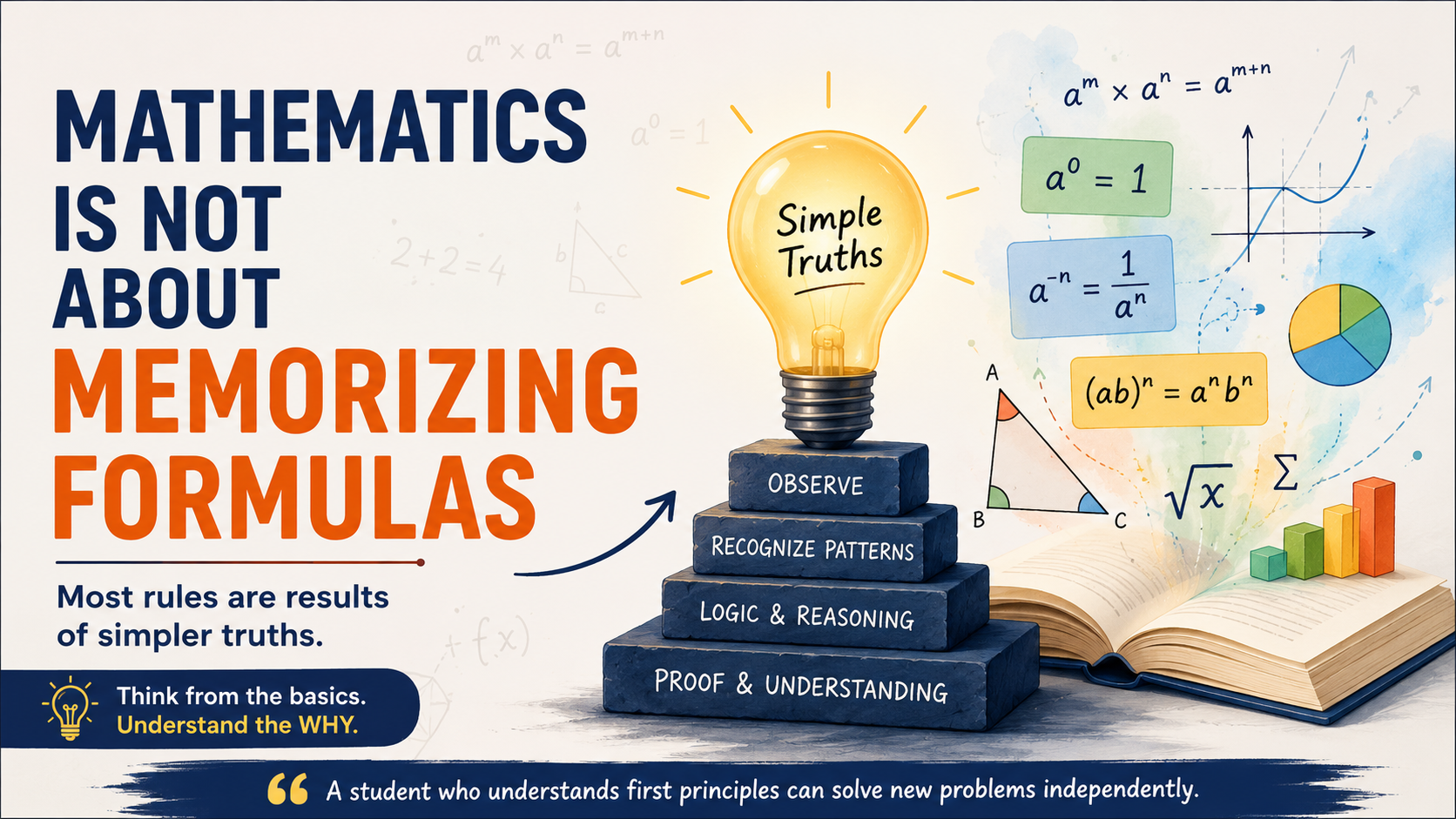
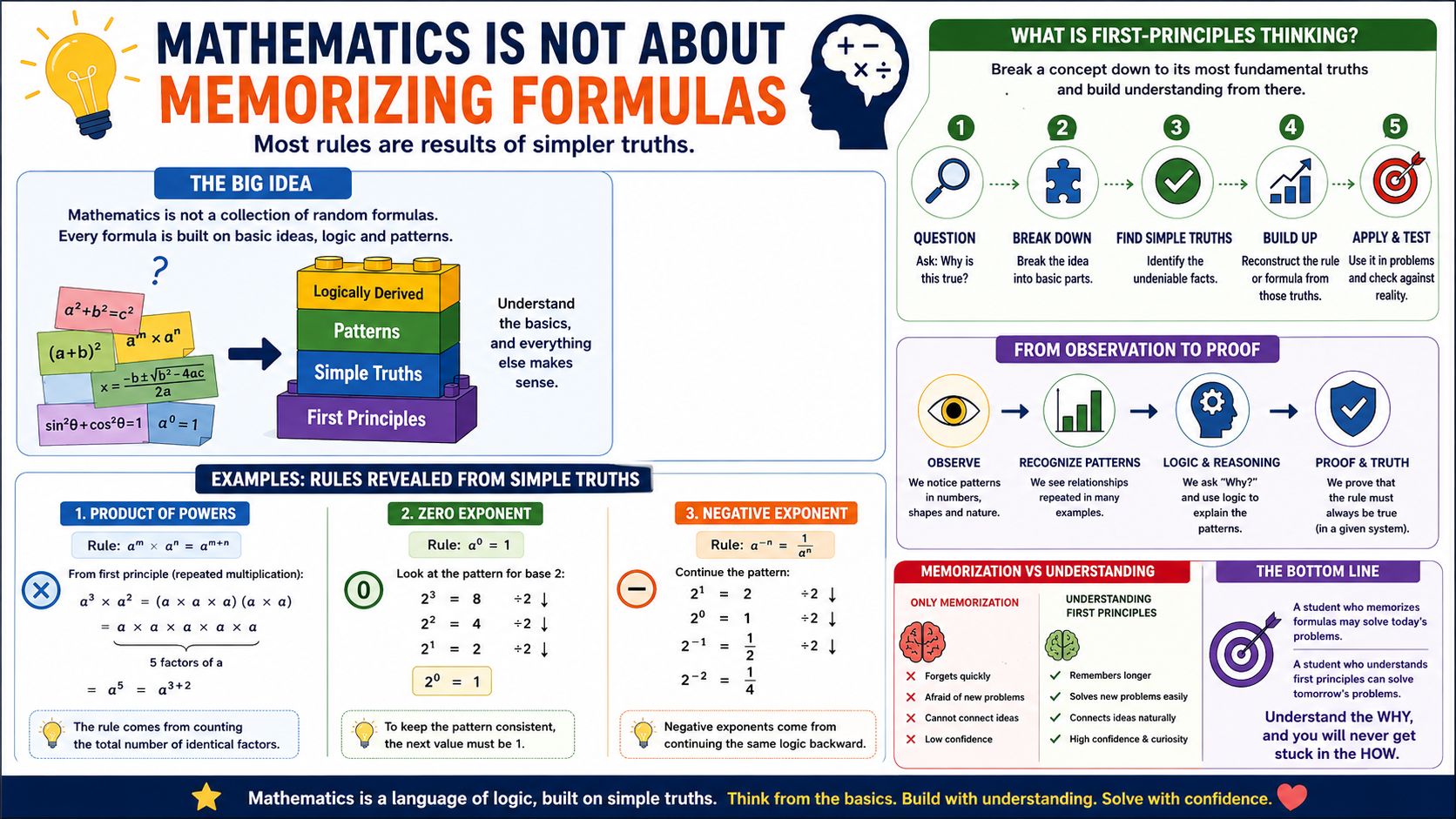
Mathematics is not a collection of random formulas.
Most mathematical rules are results of simpler truths.
When students understand this idea, mathematics changes from a “memory game” into a logical and beautiful system of thinking.
What Is First-Principles Thinking?
First-principles thinking means breaking a problem down into its most basic truths and building understanding from there.
Instead of asking:
“What formula should I use?”
we ask:
“Why does this formula work?”
This is how real mathematical understanding develops.
Example 1: Understanding Indices
Students often memorize this rule:
But where does this rule come from?
Let’s start from the basic meaning of exponents.
$ a^3 = a \times a \times a $
$ a^2 = a \times a $
Now multiply them:
$ (a \times a \times a)(a \times a) $
There are five total a’s:
$ a^5 $
So:
$a^3 \times a^2 = a^5 $
The rule was not invented randomly.
It naturally comes from repeated multiplication.
This is mathematics through understanding, not memorization.
Example 2: Why Is Anything Raised to Zero Equal to One?
Students memorize:
But why?
Look at the pattern:
$ 2^3 = 8 $
$ 2^2 = 4 $
$ 2^1 = 2 $
Each step divides by 2.
So the next step must be:
$ 2^0 = 1 $
Again, the rule comes from pattern consistency and logical reasoning.
Mathematics Begins With Observation
Mathematics starts when we observe patterns.
For example:
- Numbers grow in patterns.
- Shapes follow symmetry.
- Repeated multiplication creates powers.
- Repeated addition creates multiplication.
But observation alone is not enough.
Mathematics then uses logic to explain why those patterns must always be true.
That is what makes mathematics powerful.
The Problem With Memorization-Based Learning
When students only memorize formulas:
- they forget quickly,
- become afraid of unfamiliar questions,
- struggle in higher mathematics,
- and lose confidence.
But when students understand the “why” behind formulas:
- learning becomes easier,
- concepts connect naturally,
- problem-solving improves,
- and mathematics becomes enjoyable.
How We Should Teach Mathematics
Instead of saying:
“Memorize this formula.”
teachers should ask:
- What does this actually mean?
- Can we expand it?
- What pattern do we notice?
- Why must this rule be true?
These questions train mathematical thinking.
Mathematics Is a Language of Logic
Mathematics is not magic.
It is a structured way of thinking built from:
- observation,
- patterns,
- reasoning,
- and proof.
Every formula has a story behind it.
When students learn that story, mathematics becomes meaningful.
Final Thought
A student who memorizes formulas may solve today’s problems.
But a student who understands first principles can solve new problems independently.
That is the true purpose of mathematics education.
Understanding is always more powerful than memorization.