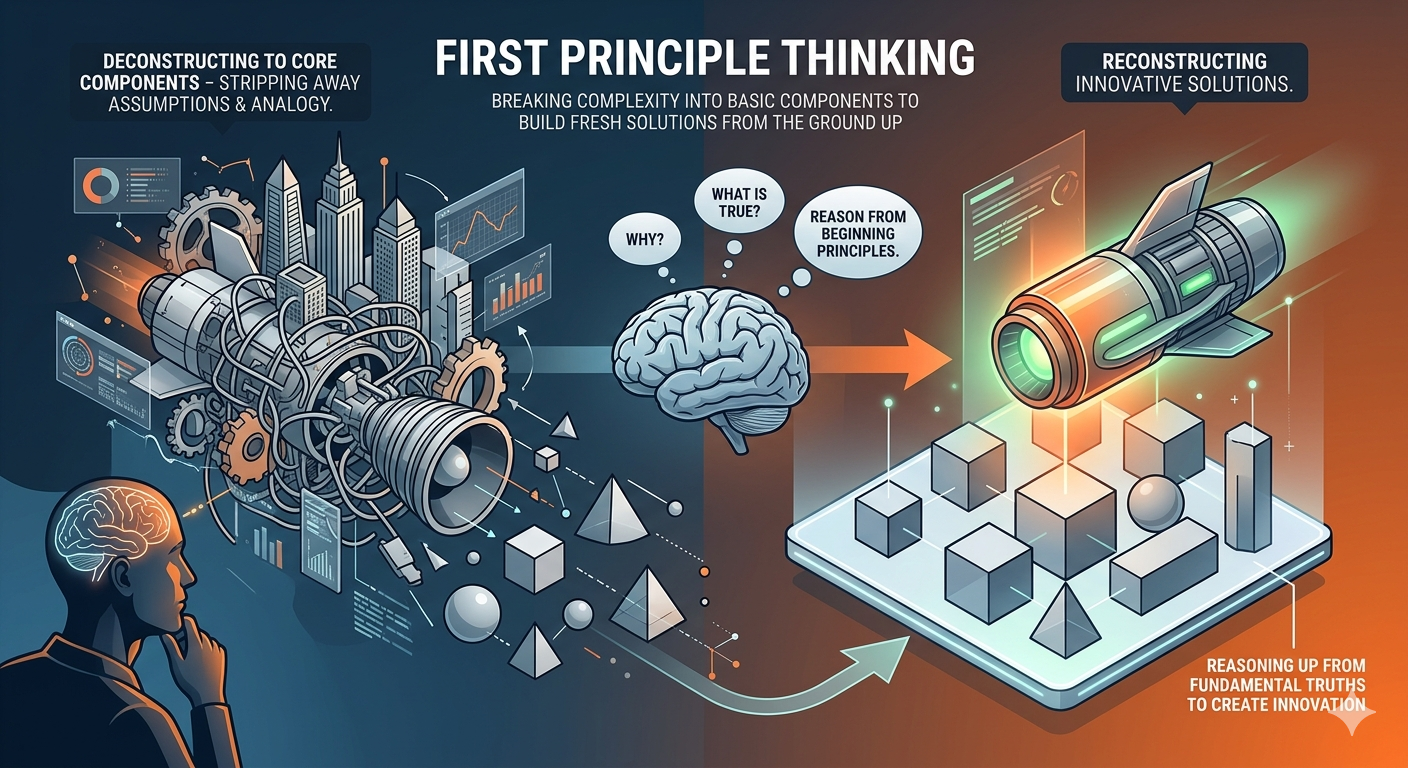
Peel back the assumption.
Find what's actually true.
This is the heart of First Principle Thinking — a way of solving problems by going back to the most basic, undeniable truth, instead of copying what was done before.
What does "first principles" actually mean?
A first principle is a basic truth that you cannot break down any further — and that you are certain is actually true, not just assumed. First Principle Thinking means taking a problem, breaking it down into these basic truths (आधारभूत सत्य — aadhaarbhoot satya), and then building your answer back up from there, instead of copying an answer someone else already gave.
Think of an onion. From the outside, it looks like one solid thing. But if you peel it, layer by layer, you reach the core — the simplest part it is built from. First principle thinking is the act of peeling away assumptions (मानेका कुराहरू — maaneka kuraaharu) until you reach that core.
The outer rings are assumptions and habits picked up from others. The small core in the centre is the basic truth — what first principle thinking is trying to reach.
The everyday alternative: thinking by copying
Most of our daily thinking is reasoning by analogy (तुलना गरेर सोच्ने) — we look at what worked before and copy it with small changes. It is fast, and it works for routine situations. But it cannot handle a truly new problem, because you are copying a result without understanding why it worked.
Three examples, from small to big
1. Why does a paper boat float?
Most children just believe "paper boats float" because they've seen it happen. That's copying an observation, not understanding it.
A first-principle question goes deeper: why does anything float at all? The basic truth is that an object floats when it pushes away (displaces) more water-weight than its own weight. A paper boat is light and spreads out flat, so it pushes aside enough water to hold itself up. Once you know this one basic truth, you can predict whether a stone, a leaf, or a steel ship will float — without ever testing each one by hand.
2. Solving a maths problem you've never seen before
A student who only memorises solved examples gets stuck the moment a question is asked in a slightly different way — because they copied steps without understanding the rule behind them.
A first-principle student asks: what basic rule (नियम) is this question actually testing? For example, instead of memorising "area of a triangle is half base times height," they understand why — a triangle is exactly half of a rectangle drawn around it. Once that basic truth is clear, the same student can also work out the area of a parallelogram, a kite, or an odd-shaped field, because they are reasoning from the basic truth, not from a memorised line.
3. Why rockets used to cost so much
For decades, rocket companies built spacecraft by buying pre-made parts from other suppliers, at high prices — simply because that was the accepted way of doing it. This was reasoning by copying old industry habits.
One engineer asked a first-principle question instead: what is a rocket actually made of, at the most basic level? The answer was ordinary raw materials — aluminium, titanium, copper, carbon fibre — which by themselves cost only a small fraction of the price of a finished rocket. The high cost was coming from how the rocket industry had always done business, not from the materials themselves. By starting again from the raw materials and building parts directly, the cost of building rockets dropped sharply.
A simple method you can try today
- Name the problem clearly. Write down, in your own words, exactly what you are trying to solve.
- Ask "Why?" again and again until you reach something you are completely sure is true — a fact with no more "why" left to ask.
- List only the basic truths you found. Leave out opinions and "this is just how it's done."
- Rebuild your answer from those basic truths, one step at a time — like stacking the layers of the onion back up, but now you understand each one.
- Test it against the original problem. Does your answer truly solve it, or did you quietly copy an old solution again?
Try this right now
Choose one subject you are studying this week. Ask yourself: "What is the one basic rule behind this, that I have simply accepted without ever questioning it?" Write that question down. That single question is the seed of first principle thinking.
Word helper
| First principle | आधारभूत सिद्धान्त — a basic truth that cannot be broken down further |
| Assumption | मानेको कुरा — something believed true without checking |
| Reasoning by analogy | तुलना गरेर सोच्ने — solving a problem by copying a similar past solution |
| Raw material | कच्चा सामान — the basic, unprocessed material something is built from |
Don't just learn what is true. Learn why it is true — that is where real thinking begins.